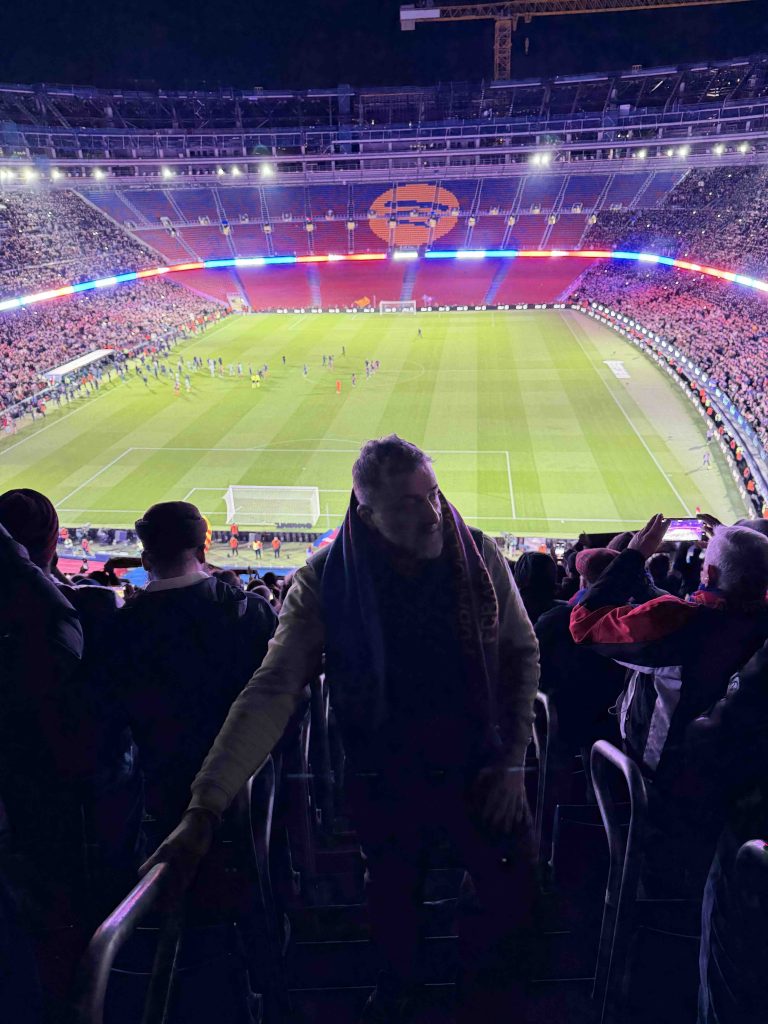
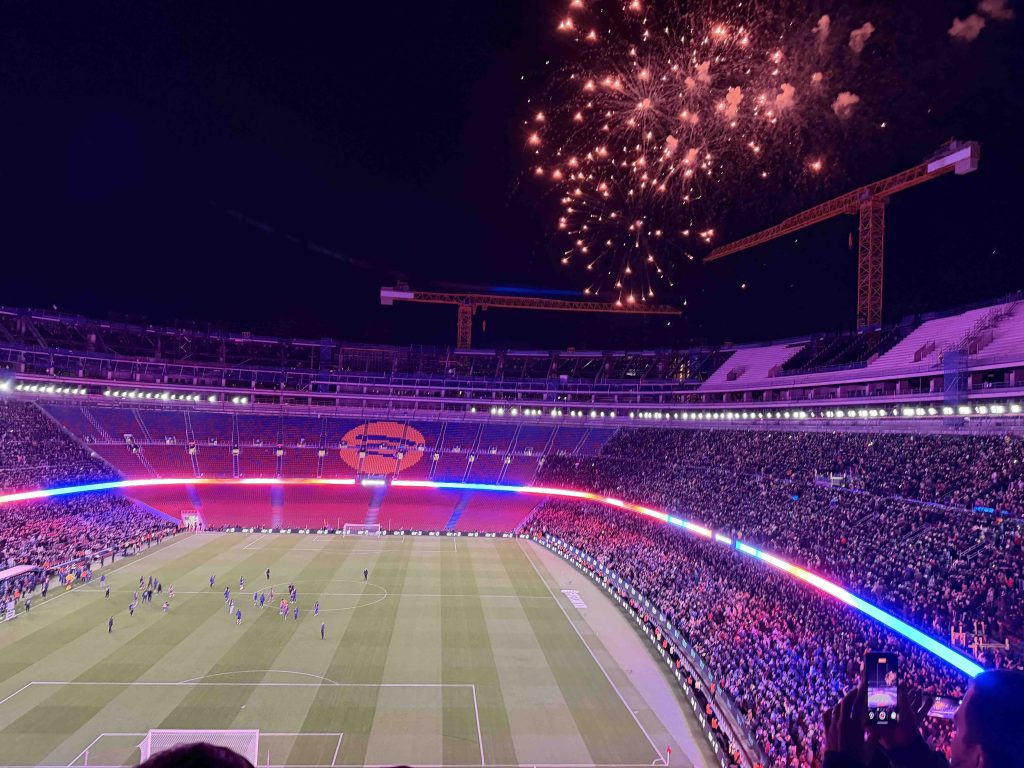
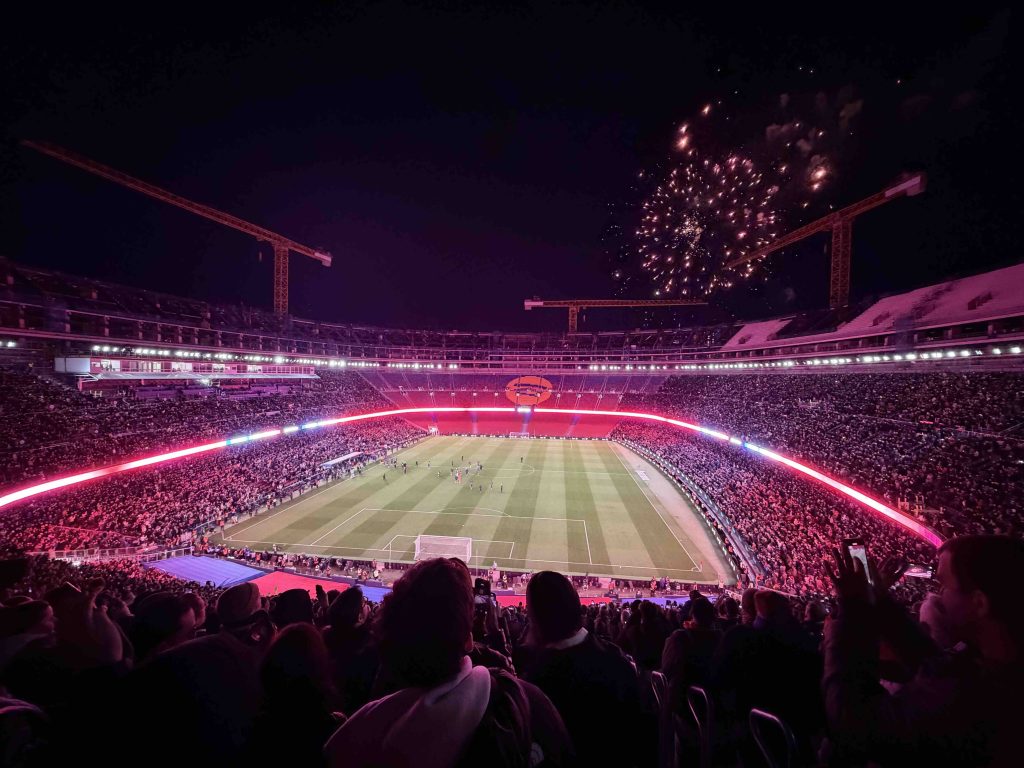
I was at Camp Nou just a few days ago, watching the first game at the renovated Camo Nou (Barcelona VS Athletic Club), and honestly, nothing prepared me for what I saw. Forget everything you remember about the old Camp Nou, the concrete, the exposed staircases, the familiar imperfections we all accepted because “that’s Camp Nou.”
What I walked into felt like stepping into the future while the future is still being built. It’s raw, alive, and full of creative technology.
Even from the outside, the transformation hits you immediately. Massive cranes circle the site like mechanical giants, and layers of new steel begin curved for the upcoming roof. But the energy isn’t just architectural… it’s digital. You feel it. The whole place is slowly turning into the smartest sports arena on the planet & you can sense the intelligence forming behind.
As I moved closer, one engineer told me, “This stadium will think.” & it clicked that’s exactly the story unfolding here. Camp Nou isn’t being renovated.. it’s being rebooted.
Inside the structure, you see the skeleton of the new 360 degree halo screen that surround the pitch. Even incomplete, it’s unreal. Imagine a screen so wide and so seamless that it becomes part of the sky above the match, reacting in real time to everything happening below. AI will drive it, adapting visuals to crowd noise, match tension, sponsor moments, even emergency scenarios. Standing there, looking up at the empty frame, I could already imagine it lighting up the night.
Everywhere I turned, technology was hiding behind temporary walls: fiber lines, sensor arrays, intelligent ventilation modules waiting to be installed. The workers talked about AI driven crowd management as casually as someone discussing the weather.
The idea is simple, the stadium will actually learn how people move. It will predict bottlenecks, redirect flows, adjust lighting, and even balance power usage based on live foot traffic. This isn’t a stadium, it’s an IOT city simulator with a pitch in the center.
One highlight was climbing up toward the future concourse zone. It’s massive. You suddenly understand how the renovation plans to absorb 105,000 fans with ease. Wide ramps, panoramic openings, and enough space for digital installations, AR experiences, and interactive screens.
I could almost picture thousands of people moving effortlessly, guided by AI navigation through Barça’s app.. “Turn left for your seat.”, “Nearest restroom: 20 steps.”, “Bar queue.. 4 minutes.”
And then there’s sustainability, the kind that doesn’t feel like a slogan, but a system. The new roof will be covered with solar panels & AI will distribute the energy intelligently across the entire campus. Cooling, heating, lighting… everything operates in a constant self optimization loop. You walk around and realize this isn’t just smart, it’s self aware.
But the moment that really got me? Standing at pitch level.
All the noise from the construction faded into the background for a second. I imagined the AI powered tracking cameras, the edge computing units analyzing player movement in real time, the coaching dashboards lighting up with possibilities. The stadium will not only host matches, it will feed Barça’s football brain with instant tactical insights, data streams, and predictive patterns. This place is becoming a football laboratory.
Walking out, covered in a bit of dust, I felt something strange, nostalgia and excitement mixed into one. Barcelona is keeping the soul of Camp Nou, but giving it a digital heartbeat. And after seeing it up close, I can honestly say.. the new Spotify Camp Nou won’t just be a stadium you visit. It’ll be a stadium you experience.